

The Bottom Line Up Front: Yes. DistroKid, TuneCore, and CD Baby are Distributors, not Publishers. Their primary job is to collect “Master Royalties” from streams. They do not automatically collect “Mechanical Royalties” or “International Performance Royalties” for your songwriting. Unless you have a separate publishing agreement, roughly 15–20% of your total earned income is sitting in a “black box” that you cannot access.
It’s the most common trap in the independent music world.
You pay your $20–$50 a year to a distributor, you see your music on Spotify, and you think the pipeline is complete. But for every dollar your music earns, there are actually two different types of money being generated.
If you only have a distributor, you are only catching one of them.
The “Hidden” Money Your Distributor Misses
When a song is streamed on Spotify or Apple Music, two copyrights are being used:
- The Master (The Sound Recording): This is what DistroKid/TuneCore collects.
- The Composition (The Songwriting/Lyrics): This is what a Publisher collects.
The Reality Check: Even if you are a “solo artist” who writes and records everything yourself, the industry still treats these as two separate piles of money. If you don’t have a publisher, your songwriting money stays with the societies (like The MLC) and eventually gets redistributed to major labels after a few years.
Why “DistroKid Publishing” or “TuneCore Publishing” Isn’t Always the Answer
Most big distributors now offer a “Publishing” add-on for an extra fee. While these are better than nothing, there are three reasons many pros avoid them:
- The “Hidden” Fees: Some distributors take a 15–20% commission on top of the yearly fee you already pay them.
- The “Locked-In” Problem: If you ever want to leave that distributor, moving your publishing catalog can be a legal nightmare.
- Lack of “Creative” Support: A distributor-based publisher is usually just a computer program. They aren’t actively pitching your music for Netflix shows or ads.
Stat-Bait: Industry data shows that for every $1,000 earned in Master Royalties, there is typically an additional **$120 to $180** generated in Publishing Royalties that a standard distributor cannot touch.
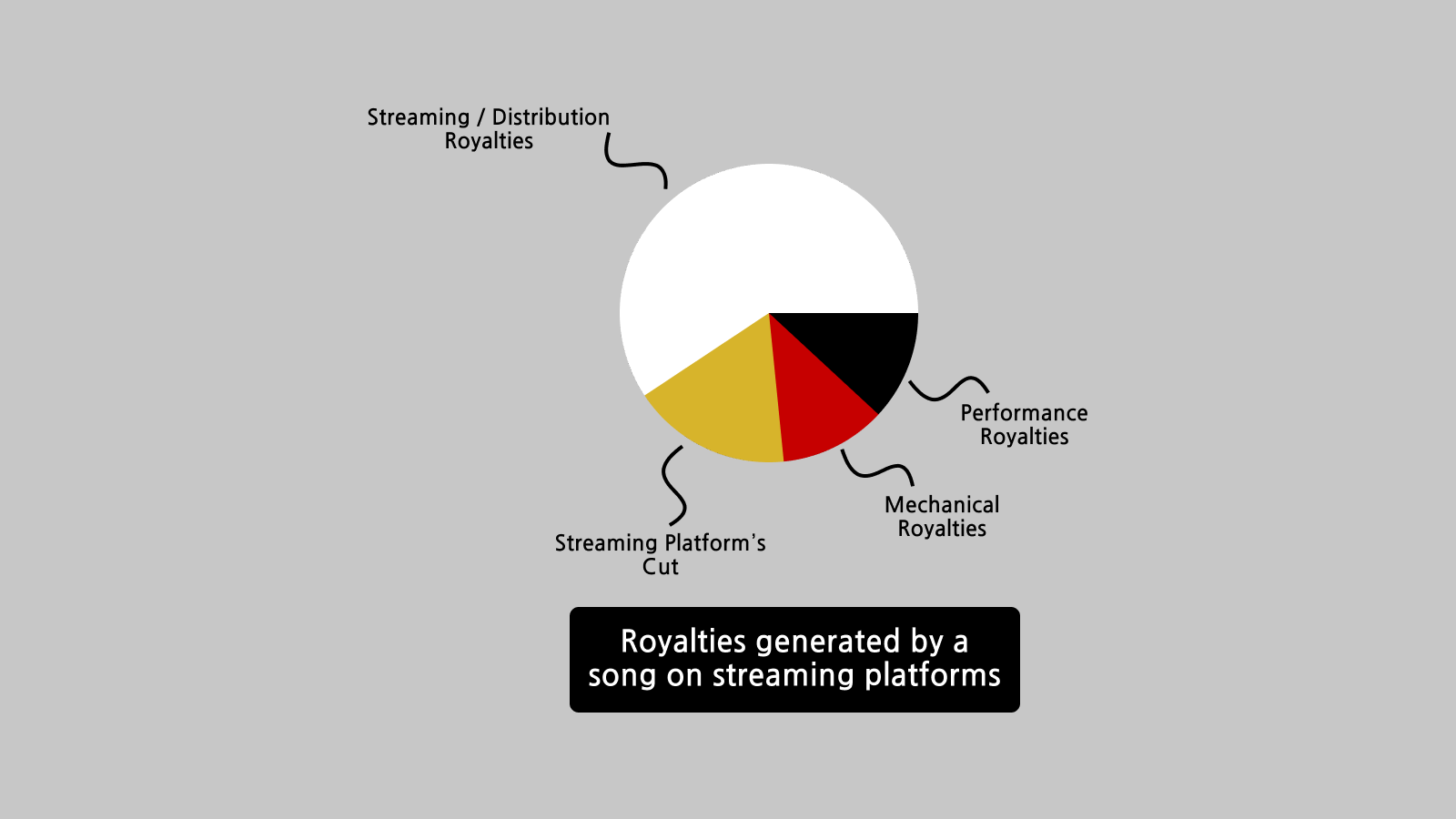
The 3 Things a Distributor CANNOT Collect
To prove why you need a dedicated publisher (like Audiobulb), look at these three specific revenue streams:
1. Mechanical Royalties (The MLC)
In the United States, “Mechanicals” are paid to the Mechanical Licensing Collective (The MLC). DistroKid does not have the legal right to collect this for you unless you pay for their specific publishing service.
2. International “Black Box” Income
When someone in the UK or India streams your song, the local societies collect that money. If you don’t have a publisher with Sub-Publishing relationships in those countries, that money sits in a “Black Box” for 2–3 years and is then given to the biggest artists in that country.
3. Sync Licensing Fees
If a YouTuber with 5 million subscribers or a TV show wants to use your song, they need a “Sync License.” Distributors do not handle these negotiations. A publisher does.
Comparison: Standard Distribution vs. Full Publishing
| Feature | Standard DistroKid / TuneCore | Full Publishing (Audiobulb) |
| Spotify Streams | ✅ Yes (Master Share) | ✅ Yes (Songwriter Share) |
| Radio Airplay | ❌ No | ✅ Yes |
| Global Mechanicals | ❌ No | ✅ Yes |
| Sync Pitching | ❌ No | ✅ Yes |
| YouTube Content ID | ⚠️ Sometimes (Extra Fee) | ✅ Yes (Included) |
FAQ: Publishing for Distributed Artists
Does DistroKid own my music?
No. DistroKid is a service provider, not a label or a publisher. You retain 100% ownership, but they only have the right to distribute the audio.
If I have ASCAP/BMI, do I still need a publisher?
Yes. As we covered in our Distributor vs. PRO vs. Publisher guide, ASCAP and BMI only collect “Performance” royalties. They do not collect “Mechanical” royalties. You need a publisher to get both.
Can I add a publisher later?
Yes, but it is difficult. Royalties are often only held for a certain amount of time (usually 2–3 years). If you wait too long to get a publisher, your past royalties may be gone forever.
Summary: Don’t Leave Your Money to the “Black Box”
If you are serious about your music career, you need to stop viewing publishing as an “extra.” It is half of your business.
Using a distributor to get on Spotify is Step 1. Using a publisher to secure your rights is Step 2.
Your Next Step: If you have music currently live on streaming platforms, use a service like Audiobulb to audit your catalog and ensure your songwriting is registered globally. Every stream you get today is generating money, make sure it’s coming to you.